Intermedia studio – Week 7 and 8

Intermedia studio – Week 7 and 8

WEEK 7:

– testing hairspray as a stiffing medium for the chosen fabric (silky polyester fabric and tulle fabric) >> comparison with pva (similar/same size) to see which better conveys […] >> another idea – using a fabric stiffener spray or a natural fabric stiffener (need to experiment with)

Hairspray:

PVA glue:

DISPLAY IDEA: PROTEST BANNER IDEOLOGY:

  • using 2 pieces of wood (sticks?) to (possibly) stretch the fabric layer(s) of fabric when after applying pva glue in order to stiffen and ‘capture’ textures and movement of the fabric
  • ideology used to express emotional values of instability within the painting in reference to anxiety and personality disorders, through indirect/silent ‘protest’ – the viewer might not be interested in the piece due to the implicity of meaning of the piece, but perhaps this could be something that makes the viewer wonder about the artist’s intentions*
  • perhaps I could consider not using pva glue if taking this ideology further, this may also depend on display

* this should be further discussed, perhaps supporting material will be needed

> playing with the language word play: banner (en) > transparent (pl)

WEEK 8:

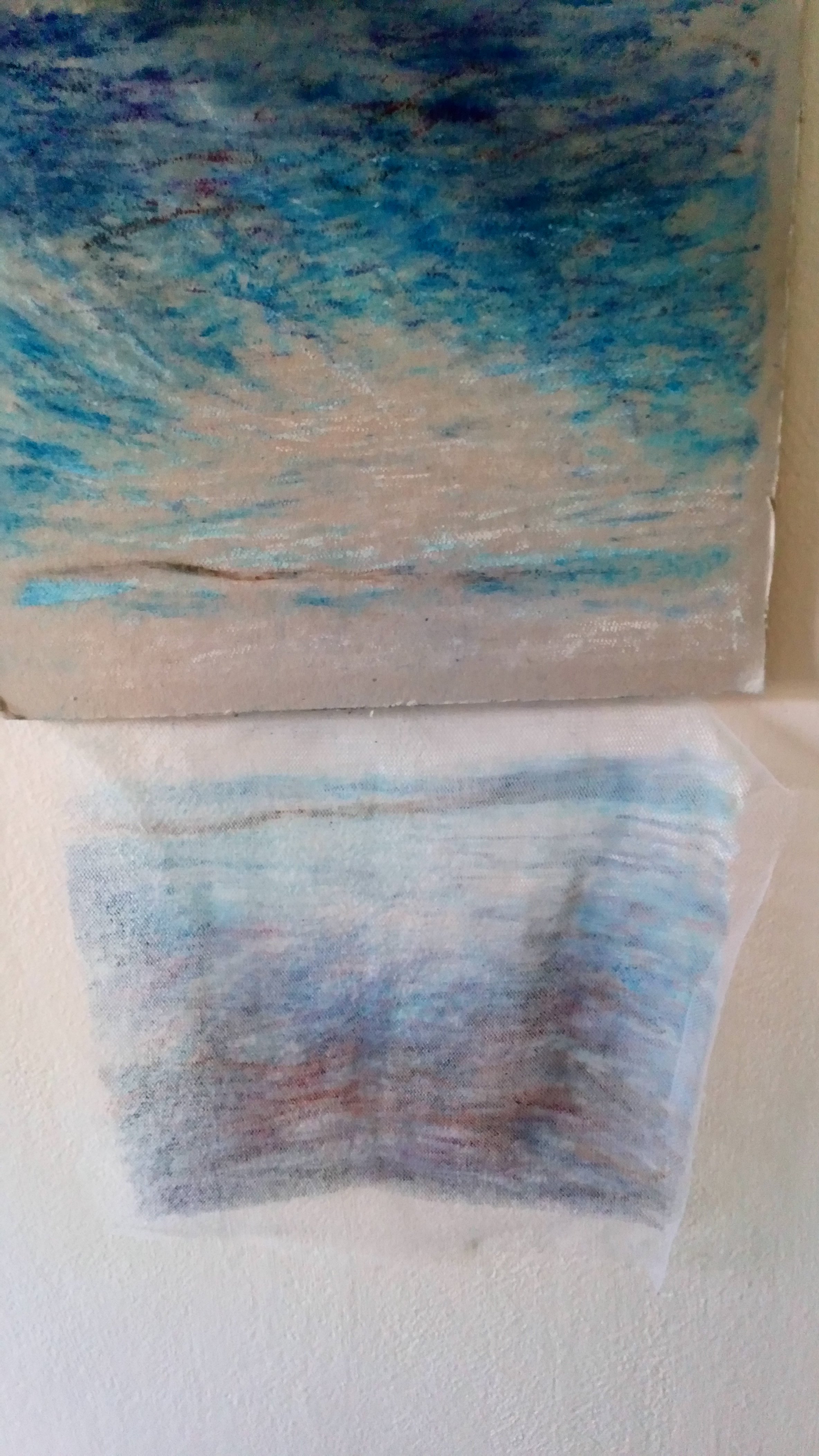
3 primer options – emanel paint, paint+pva glue and just pva glue

I’ve chosen the emanel paint as the primer – texture is the most interesting

CLOSE UPS:

Cardboard:

Satin fabric:

Tulle fabric:

As you can see, there are slight differences on the cardboard because that’s where the medium/primer is applied

Now I want to experiment with the number of fabric layers, I have switched the order in this I layer the fabrics: now, the tulle fabric at the bottom, silky fabric at the top*

* this order may be benefiticial for me as it is easier to apply paint on a smoother surface which the tulle fabric does not quite provide

> display idea : unconventional stretcher, protest banner idea, pva glue to stiffen fabric

Intermedia studio – Week 5 and 6

Intermedia studio – Week 5 and 6

WEEK 5:

  • testing different (sheer) fabric

To consider: adding depth to the layers by using PVA glue to ‘solidify’ the fabric layer – may create a sense of movement in the painting >> instability look at a post “Experiments” from Summer Project for reference (photographic)

>> plan to go bigger? + oil painting + watercolour board to absorb the paint more efficiently? or use the same grey cardboard but with a layer of gesso (as base)idea for display: similar to demonstration banners – demonstration/protest/exposing of own feelings/ emotional instability – in reference to various mental disorders – performative use?[consider display + using the fabric layer as a ‘sculpture’]

WEEK 6:
larger scale >> test out different primer options when using a grey board: acrylic paint vs. pva glue vs. acrylic paint+ pva glue mixed >> oil paint opposed to oil pastels as they are more effective in a way of depicting the idea of translation; blending, textures etc. >> layering two fabrics (tulle and polyester)

Studio of Intermedia Confrontation – continuous art practice (Week 3 – 4 of Autumn semester)

Studio of Intermedia Confrontation – continuous art practice (Week 3 – 4 of Autumn semester)

WEEK 3:
IDEAS:

– continuing (from last year) using same kind of fabric (sheer, transparent) but in relation to a slightly different topic relating to materiality and semantics/theme — Transparency/ Translation (topic with diverse references to current issues and other topics and themes)

TRANSPARENCY: still working with layers*

– addition of text- as relevant to translation and communication, translation is particular could be particularly interesting when using text and the translation of emotion onto art medium (which is highly relevant to art and art therapy – emotive language)

– focus on language and the way language is used as a medium of communication and translation of inner thoughts and feelings

* of different characterics – similar to oil pain stains on A3 paper from last year


EXPERIMENT:


IDEAS behind this experimental piece: Issue: communication in autistic spectrum disorder (ASD) – lyrics of “Autystyczny” (original in Polish) by Luxtorpeda* – paritular part of lyrics used to represent the two-sided issue of communication within families dealing with autistic spectrum disorder, this regards both literal communication and emotional issues – the colour of blue has been chosen to be paired up with white as it is not only easy to read, but blue is also the colour of autism – both transparency and lack of transparency are shown –> first piece shows transparency hence sheer fabric used and the secondary outcome (‘translation’) and the text relates to the emotional struggles of someone with ASD, whereas the second was done on a non-transparent fabric resulting in only one outcome, relevant to the text, which is talking about the natural, direct emotional bond between a child with ASD and a family member, especially the mother — if to further explore ASD communication, synaethesthesia could be considered (seeing numbers as colours etc.) as this condition is common in children with ASD

* more info under WEEK 4

WEEK 4:

I’ve decided to accompany this piece with literal direct translation of the text, which is something to consider and discuss as the reason behind is that I wanted to show another aspect of translation that everybody to relate  to the language to language translation and this issue is particularly key for me now being on a study abroad in Prague (Czech Republic) – this expands the idea of ideas being ‘lost in translation’ which is something I’d like to further explore, perhaps in larger scale and with reference to DADA art movement (different meaning of the same word in different languages)

MEDIUM: at the moment, I’d like to focus on 2D aspect of my work, afterwards I may consider spatial location of my pieces or even installation as sculpture or having 3D parts on a 2D installation/painting

Venice Biennale 2019 – Artist Inspiration

Venice Biennale 2019 – Artist Inspiration

While studying in AAAD in Prague, I got the chance to go on a trip to Venice for the Venice Biennale. Having seen a lot of art in Venice Biennale, I’d like to highlight some of artists and artworks that can be relevant to my practice or in my future art practice (found interesting) :

COUNTRIES:

  1. Czech Republic and Slovak Republic (https://www.labiennale.org/en/art/2019/national-participations/czech-republic-and-slovak-republic)
  2. Ireland (https://www.labiennale.org/en/art/2019/national-participations/ireland)
  3. Grand Duchy of Luxembourg () https://www.labiennale.org/en/art/2019/national-participations/grand-duchy-luxembourg
  4. Madagascar (https://www.labiennale.org/en/art/2019/national-participations/madagascar)
  5. Nordic countries (Finland, Norway and Sweden) (https://www.labiennale.org/en/art/2019/national-participations/nordic-countries-finland-norway-sweden)
  6. The Netherlands (https://www.labiennale.org/en/art/2019/national-participations/netherlands)
  7. Peru (https://www.labiennale.org/en/art/2019/national-participations/peru)
  8. Poland (https://www.labiennale.org/en/art/2019/national-participations/poland)
  9. Portugal (https://www.labiennale.org/en/art/2019/national-participations/portugal)
  10. Saudi Arabia (https://www.labiennale.org/en/art/2019/national-participations/saudi-arabia)

Collateral and Artists: 

Experiments

Experiments

EXPERIMENT 1: More of an investigation of fabric properties – 4 different fabrics – using scale weights – increased tension of material on hooks 

Scale weights – too small, 2 other fabric samples could not be used to show the progression on tensile strenght of the fabric 

EXPERIMENT 2: Using PVA glue to capture movement and texture of fabric – wave 

Planning – Problem Regarding Material – Practice Specific

Planning – Problem Regarding Material – Practice Specific

ANSWERS TO QUESTIONS FROM THE BRIEF:

The problem – tractability and practicality of fabric, especially delicate fabric (as a material, main medium) in (3D) sculpture/installation

This problem is important because fabric has begun to interest me in many ways and I’d like to use it in my further practice; I’ve experimented with organza fabric as a medium for paintings and ended up displaying my work as a 3D installation.

The problem affects many artists – focusing on the medium in their practice, but mainly my own practice. It limits and disables artists to use the idea of fragility in form of sculptural artowork/ piece.

The causality of the problem stems from the material itself – its characteristics; specific.

If the problem does not get solved, it will still be difficult to present emotion and vulnerability in sculpture without showing the end product in form a representation of the impact of manual work on the fabric. However, many artists may prefer this direct approach as it depicts the nature and authenticity of the medium, which of course should be important.

I think that I can solve this problem on my own, at least start exploring possible solutions or allowing and evaluating different approaches.

This problem is connected to the way viewers interpret sculpture and its installation – the influence of medium in interpretation (physical/tactile features). This is something every artist considers and tackles accordingly tot he expertise.

Durability of solutions >> SEE EXPERIMENTS

How will the work best communicate these solutions through your artwork? >> SEE EXPERIMENTS – simply working with the medium – reflects focus on the medium in my practice

What have you discovered along the way? >> SEE EXPERIMENTS

Project Brief

Project Brief

Studio3 summer project: Solve a problem                         

[for students entering Studio3 Autumn 2019]

Art enables us to see things differently, imaginatively, practically, materially and fantastically, in various forms and dimensions.

Identify a problem; this might be global, local, personal, practical, material or philosophical.

Set about solving this problem.

Make an artwork or series of works in response to your identified problem and your approach to solving it.

Document all stages of your project, including research and outcomes. This might include: visualising the problem; documentation of tested solutions; visual and/or material outcomes and impacts, both of the problem and its solutions; recording responses – yours and others.

Your identified problem might be: small and contained, eg mending a bike tyre; or massive and global, eg climate change; personal (relationship; finance); or political.

[Note that “the personal is political” and even small practical tasks have philosophical ramifications; read Zen and the art of motorcycle maintenance and look at artwork of Mierle Laderman Ukeles and Andrea Zittel.]

If your solution is not immediately solvable, create detailed plans as to how it could be achieved (see Janice Kerbel’s Bank Job and other works).

You might identify a problem and its resolution in relation to your own practice, such as struggling to master a skill or technique.

Consider the following questions (document your responses):

  • What is the problem?
  • Why is it important to solve this particular problem?
  • Who does the problem affect and how?
  • What has caused the problem?
  • What will happen if this problem is not solved?
  • Can you solve it on your own or do you need to involve others?
  • How will you persuade others to get involved?
  • Is your identified problem masking or connected to other underlying problems? (Try to separate these out and consider whether they should be tackled separately.)
  • How durable are your solutions?
  • How will you best communicate these solutions through your artwork?
  • What have you discovered along the way?

In all instances, consider and test a range of possible solutions, both small scale and practical, wide ranging and fantastical.

Reflect on your artwork in relation to the problem; how much is it part of the solution? Can it be appreciated in its own right; does it have its own internal coherence as an artwork?

Install your artwork and/or related documentation in Studio3 at the beginning of the Autumn Term 2019, ready for discussion. Also, include it on your blog in a clearly marked section (especially if you’re on Study Abroad).